
Launched in 2022 for five years with the funding of the Banque Publique d’Investissement (BPI), the French part of the European IPCEI ME/CT project aims to stimulate innovation in 5G technologies. Coordinated by Orange, the collaborative aspect of the project in France brings together academic partners (IMT, CNAM, EURECOM, CEA) and industrial partners (Obvios, Ekinops, Kalray). Together, they are exploring new avenues for 5G covering different topics: O-RAN radio networks, automation, intelligent data use, connected vehicles and private mobile networks. The aim is to put forward innovations to evolve 5G and its market.
This platform is the first step in deploying distributed, open-source, programmable and modular network infrastructure platforms that could serve as a foundation for future telecommunications networks.
In order to facilitate the integration of the various innovations produced by the partners, a telco cloud platform, Sylva, is gradually being implemented. This platform is the first step in deploying distributed, open-source, programmable and modular telco cloud infrastructure that could serve as a foundation for future telecommunications networks.
The Sylva project is an open-source project by the Linux Foundation Europe. Originally founded by European telecom carriers and manufacturers (Orange, TIM, Telefónica, Deutsche Telekom, Vodafone, Nokia, Ericsson), Sylva has become a reference stack for telecom cloud (or telco cloud).
Sylva brings a single, open-source cloud layer that accommodates any type of virtualized or cloud-native containerized network function (VNFs, CNFs). Sylva enables interoperability, automation and sustainability while offering increased efficiency in a context where rapid innovation is more important than ever.
Sylva’s evolution is based on five fundamental technical pillars:
- Performance: Sylva incorporates specific technologies to ensure high availability.
- Energy efficiency: Customers reduce their carbon footprint and energy consumption by managing their infrastructure in a pool of shared resources.
- Open source: Sylva is 100% open source and auditable, ensuring total interoperability and no supplier dependencies.
- Security: Sylva follows the most stringent technical security requirements, including EUCS.
- Automation based on a declarative approach: Sylva provides a very high level of automation to manage a large volume of nodes and clusters.
Deploying ME/CT Sylva telco cloud is done directly on servers in bare metal mode (servers made available as part of a partnership launched in 2019 between Orange and Lenovo). Two Orange laboratories in Lannion and Rennes are interconnected via a dedicated VPN and each host several telco cloud nodes and clusters. The platform is evolving to connect the various partners wishing to validate the innovative 5G solutions developed in the ME/CT project on an almost entirely virtualized experimental network and native cloud, except for radio antennas and certain signal processing software. The platform also aims to accommodate specific components provided by project members, such as Kalray cards or Ekinops open CPE (Customer Premises Equipment) enterprise routers, to check if they can be integrated in a Sylva environment.
In the French participatory IPCEI ME/CT project, Obvios Dome private 5G network industrial solution was deployed and automated on the Sylva platform. Dome includes the control plane of the 5G network with the various functions standardized by the 3GPP (AMF, SMF, AUSF, etc.), the user data transfer plane (UPF), and the supervisory and management functions. Automated deployment is ensured in clusters via charts, making it easier to integrate Dome’s monitoring and alert management system with Sylva’s platform, update versions and add remote sites managed by a single 5G core network.
End-to-end tests are performed using a radio access network and 5G devices simulator, which ensures proper operation and complete validation of the 5G network chain. The platform also enabled automated deployment testing of open-source 5G core network solutions such as free5GC and OAI Core Network.
To go further in modular network development, the project is experimenting with deploying private 5G networks with transfer functions distributed to remote sites and securely connected to a single, shared control plane on the Sylva platform. In this way, Dome 5G UPF transfer plane is based on an open enterprise router developed by Ekinops to host 5G functions at the edge of distributed enterprise network sites. This type of OVP (Open Virtual Platform) router will allow cloud-native functions to be hosted automatically directly from a single network management system deployed in the cloud. Other use cases are being studied, including all network edge services, such as virtualized radio networks or artificial intelligence implemented in Sylva clusters deployed in carriers’ PoPs (Points of Presence) or at customers’ premises.
The research work of the ME/CT project allowed the various technical components and their architecture to be developed before their deployment and integration into the Sylva telco cloud platform. This approach decouples cloud infrastructure lifecycle management from cloud native network functions that leverage this infrastructure. This requires the project to develop a high level of automation to create on-the-fly private 5G networks distributed across multiple sites.
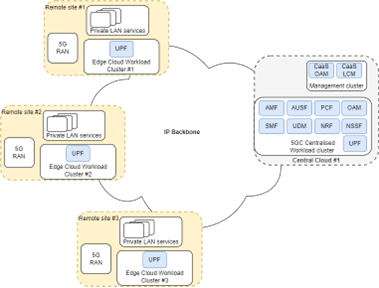
High-level design of the platform with the distribution of 5G network functions across multiple sites via Sylva telco cloud clusters.
Glossary
AMF :Access and Mobility Management Function
AUSF :Authentication Server Function
CNF :Containerized Network Function
ME/CT: Microelectronics and Communication Technologies
O-RAN: Open Radio Access Network
IPCEI :Important Project of Common European Interest
SMF :Session Management Function
UPF :User Plane Function
VNF :Virtual Network Function
People we quote
Sylva
The main carriers in Europe, together with network function providers, initiated the Sylva project to address Telco and Edge use cases.
Read more
Read more
- Obvios Dome 5G network: https://obvios.eu/
- Ekinops open CPE: https://www.ekinops.com/products-services/products/oneaccess/ucpe/ovp
- free5GC: https://free5gc.org/
- OAI Core Network: https://openairinterface.org/
Authors
Fabrice Guillemin
Architecture for Virtualized Networks (AVN) Program Manager
Researcher