
On the standardization of the triple coexistence of three PON technologies
Since 2006, Orange has been deploying fiber to homes (FTTH-Fiber To The Home) and to businesses (FTTE-Fiber To The Enterprise). Orange’s fiber access networks are based on passive infrastructures (fibers, cables, connectors, boxes, etc.) and transmission systems called PON, which stands for « Passive Optical Networks. » Some future uses may generate increased traffic demands, and Orange is already increasing the capacity of its PON transmission systems by deploying XGS-PON (10G symmetrical-PON) on these networks, which has a downstream speed four times higher than the previous technology, G-PON. Orange has chosen these technologies because they are based on ITU-T standards defined in agreement with other international operators (China Mobile, NTT, China Unicom, China Telecom, Verizon, BT, AT&T, and others) as well as network equipment manufacturers. To prepare the future FTTH network and meet upcoming needs, Orange has been a pioneer in this field by supporting the standardization of the next generation of PON: 50G-PON. Particularly supported by Orange, the triple coexistence of three PON technologies on the same fiber infrastructure has been made possible by specifying an optical spectrum (wavelength plan) to enable this triple coexistence in the ITU-T standard. This corresponds to the « US3 » option of the wavelength plan showed below.
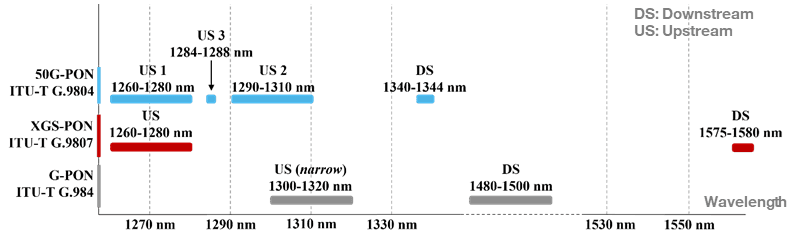
Wavelength plan of G-PON, XGS-PON and 50G-PON technologies according to ITU-T
This wavelength plan has been standardized so that each wavelength of the three PON technologies does not overlap and interact when transmitted in the same fiber. This is already the case with the current deployment of XGS-PON and GPON coexisting on the same fiber deployed at our customers’ premises. Subsequently, the triple coexistence of G-PON, XGS-PON, and 50G-PON will be possible as soon as the first 50 Gbps deployment needs arise.
As shown in the following scheme, a simple network card change in the OLT (Optical Line Termination) equipment located in central offices will allow Orange to connect a fiber customer to either G-PON (with a residential or business offer currently available up to 2 Gbps), XGS-PON (with a residential or business offer currently available up to 8 Gbps), or 50G-PON with a commercial offer to be defined.
At the central office, the network card will integrate a Multi-PON-Module (MPM) optical module that includes the three PON photonic technologies. At the customer’s premises, the box will be equipped with the appropriate PON technology corresponding to the subscribed service offer.
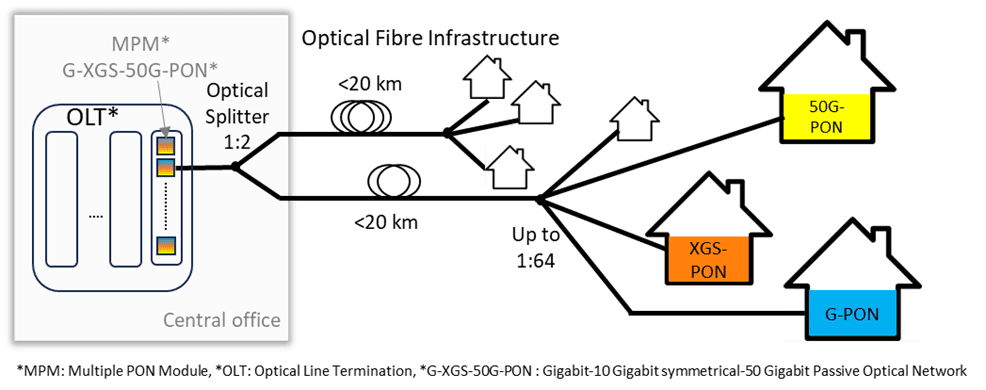
Scheme of FTTH network with triple coexistence of PON technologies
Achieving this operational simplicity required several innovations in photonics and signal processing:
- Developing and evaluating optical components (typically the Laser source) and electronics to transmit at 50 Gbps with a cost target aligned with the optical access market.
- Developing digital or analog signal processing techniques adapted to the specifics of the PON access network.
Some of these innovations are the result of collaboration between Orange Innovation and Huawei Technologies, leading to numerous joint scientific publications [1-4].
First connections from February 2024
Today, the first 50G-PON systems are reaching technological maturity and will soon be commercially available in the countries where Orange operates a fixed network (Europe and MEA). This will enable future increases in network capacity for enterprise uses, mobile network backhaul, and eventually residential uses when the demand arises.
Like the capacity evolutions in optical transport (core) networks were demonstrated during transmission records on deployed networks [5-6] , this time here, the last miles of optical networks are preparing to evolve.

Central office with field trial of G-XGS-50G-POn triple coexistence
In February 2024 in Brittany, during a field trial, Orange connected a residential fiber customer to a dedicated 50G-PON equipment on an operational FTTH infrastructure, with other commercial customers also connected via G-PON and XGS-PON. An Ethernet traffic of more than 41 Gbps was measured in real time on the link of the customer connected to the 50G-PON, while maintaining the quality of the connections for the other G-PON and XGS-PON customers. This field trial demonstrated the maturity of the 50G-PON system provided by Huawei Technologies and ensured the longevity of Orange’s FTTH networks to support future technological advancements.
To conclude
After a field trial on its operational network in France, Orange, in partnership with Huawei Technologies, demonstrates the compatibility of its FTTH (Fiber to the Home) network with the next generation of PON (Passive Optical Network) technology: 50G-PON. Standardized by ITU-T since 2021 as the post-10 Giga solution, this technology allows speeds of up to 50 Gbps and will operate in coexistence with G-PON and XGS-PON technologies, simplifying its future introduction.
To ensure that the uses of today and tomorrow always benefit from the best fiber while capitalizing on our deployed networks, it is crucial to use technologies that improve performance for our customers without interfering with each other. This triple coexistence trial aligns with this approach and confirms the relevance of the technological choices made by Orange since the beginning of the fiber deployment.
- FTTH: Fiber to the Home is used for fiber up to the house. G-PON, XGS-PON, 50G-PON are passive optical network (PON) technologies that transmit information over fiber with respective downstream speeds of 2.5 Gbps, 10 Gbps, and 50 Gbps. ITU-T is a reference standardization body for PON.
- Huawei Technologies provided the 50G-XGS-G-PON system used for this field trial. This joint study was conducted as part of the joint innovation program between Orange Innovation and Huawei Technologies.
People we quote
International Telecommunication Union
The International Telecommunication Union (ITU), in french Union Internationale des Télécommunications is the United Nations development agency specializing in information and communication technologies. The ITU-T is the sector of the ITU dealing with technical and standardization issues in telecommunications.
Read more
Read more
Demonstration at Orange Open Tech Days « fibre 50G » C10 et « Livebox Fibre » C14 in Novembre 2023 :
Press communications around this demonstration
Authors
Fabienne Saliou
Researcher at Orange
Philippe Chanclou
Researcher at Orange
Gael Simon
Researcher at Orange
Jérémy Potet
Researcher at Orange