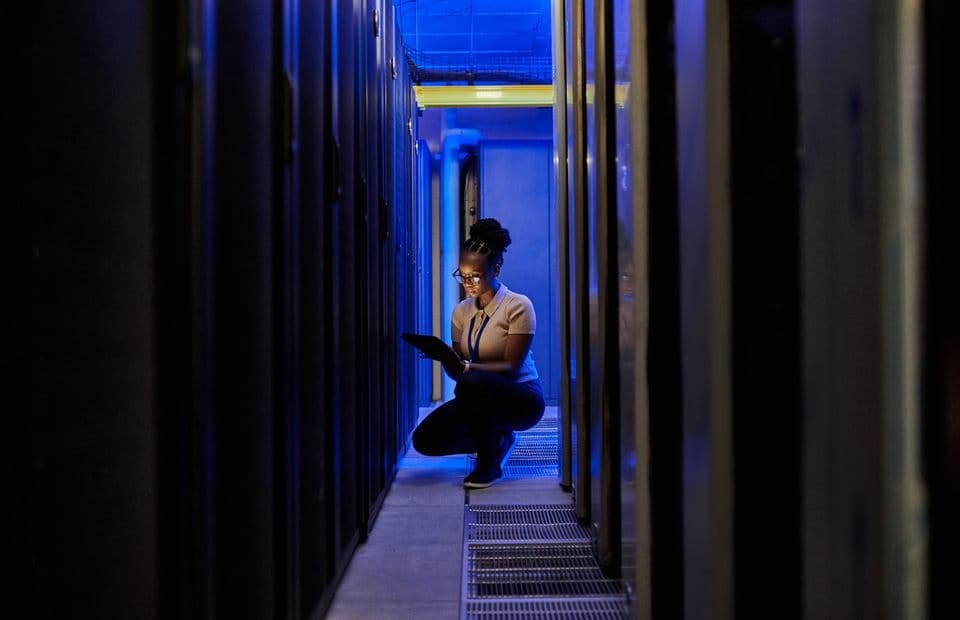
In July 2022, Google’s and Oracle’s datacentres in the UK were forced to shut down in response to record-breaking temperatures. Two months later, there was news that a heatwave had prompted a major breakdown at Twitter’s Californian datacentre. At a time when more and more research is being conducted on the environmental impact of computing, the question of how climate change will affect digital infrastructure is also under the spotlight. Writing in The Conversation in an article entitled Machines can’t always take the heat, two researchers recently explained how many machines, including cell phones, datacentres, cars and airplanes, become less efficient and degrade more quickly in extreme heat.
Frequent heatwaves can deform materials, leading to temporary and even definitive electronic component failures.
The researchers explained that at the molecular scale, temperature functions as a measure of vibration. “So the hotter it is, the more the molecules that make up everything from the air to the ground to materials in machinery vibrate. When metal is heated, the molecules in it vibrate faster and the space between them moves farther apart. This leads the metal to expand.” Put simply, frequent heatwaves can deform materials, leading to temporary and even definitive electronic component failures. And when that happens, they will need to be replaced, which in turn will generate even more heat on the level of the planet.
Major economic impact
The negative effects of heatwaves will likely have a major economic impact on the technology sector. According to a 2022 study published in Sciences Advances, between 1992 and 2013 cumulative losses to the global economy caused by anthropogenic extreme heat amounted to up to $50 trillion. At the same time, “the manufacturing process for most electronic components weighs heavily on water resources,” explains Tristan Nitot, a climate and digital environment expert for the OCTO Technology’s Frugarilla collective. In Taiwan, one of the world’s leading chip producers with factories on a vast scale like those operated by TSMC, successive heatwaves resulting in drought and water shortages have caused manufacturers to limit their production. “They have to make a choice between growing rice and manufacturing chips, in a context where local rice production is vitally important to food security because of the conflict between China and Taiwan.” Competing industrial interests may soon be embroiled in deadlock: “To comply with the Paris Agreement commitments, IT power consumption will have to be cut by a factor of five over the next few years, but right now it is steadily increasing, not least because companies are being offered economic incentives to use AI, which consumes a lot of energy.”
More efficient datacentres
Heatwaves have a major impact on the power requirements of datacentres which need to be kept within temperature limits regardless of external conditions. In the event of scorching weather, 90% of electricity consumed by datacentres is used for cooling, as opposed to 50% under normal conditions. “In the United States, some data centres consume a lot of water because they use evaporative cooling towers,” explains Guillaume Gérard, a datacentre consultant for Orange’s Green-IT team. However, in Europe, this kind of infrastructure has been banned. “In general, designs for datacentres are scaled to ensure that spraying the air-cooled condensers, that is to say the fans, with water, is enough to prevent them from reaching maximum temperatures.” However, there are alternative techniques like liquid cooling. “One solution is to have water circulating in the servers themselves, but systems like these are fragile and require extensive maintenance. The most futuristic technique is to fully submerge the servers in oil.” When they are immersed in this way, the servers are cooled by oil to water heat exchangers. “Heat exchange with the oil can increase water temperatures to 50 degrees, which makes it easier to evaporate,” concludes Guillaume Gérard.
People we quote
Tristan Nitot
Tristan Nitot is the founder of the non-profit Mozilla Europe. In recent years he has held key positions for the start-up Cozy Cloud and the search engine Qwant. Today he works on digital commons and the Anthropocene era for the Frugarilla.fr collective at OCTO Technology.
The Frugarilla Collective
An initiative launched by OCTO Technology, the Frugarilla Collective raises awareness of realistic, sustainable and therefore essential digital technology. Among other activities, the collective has set up a think tank, a podcast entitled Numériques essentiels 2030, and a number of training courses.
Guillaume Gérard
An engineer at Orange, Guillaume Gérard is in charge of the company’s green datacentre and data integration strategies, and business continuity IT architecture.