
Humanity has always held truth as an ideal, even when it is betrayed. A statement had to answer a simple question: Is it true? AI—and LLMs in particular—are shifting this standard. AI does not seek the truth at all—in fact, it could not even understand it—but instead produces what is plausible. This shift is not merely a matter of reliability; it is a rupture in our relationship with knowledge, an epistemological transformation.
Truth presupposes a relationship with the real physical world. Plausibility is satisfied with an answer that resembles what we are willing to “swallow.” A language model can construct a coherent, elegant, well-reasoned response—even, in some cases, inventing a study and its references. Everything is there, except the truth. A remarkable linguistic feat, but a very poor way to create knowledge.
This is not just my philosophical intuition (which I explore in greater detail in my book). A study has shown that LLMs can reproduce false beliefs in human texts. A study published in 2023 in “Science Advances” observed, in an experiment involving tweets, that participants were less able to recognize disinformation generated by GPT-3 than that written by humans. We’re not just dealing with errors, but with credible errors.
For researchers and engineers, this question is not abstract, for ultimately, what is the value of a perfectly crafted answer if the sources are not verified?
AI has already proven its incredible capacity for manipulation on multiple occasions, particularly in the field of advertising.
We talk about “hallucinations”—it’s a nice word. It conjures up the image of an intelligence that, from time to time, loses touch with reality. But a machine has no lived experience of the world; nor does it have human doubt, responsibility, or, ultimately, a sense of reality. It produces statements; it is we who grant them the status of knowledge; it is we who give them that value. The shift is clear: this credible form of AI becomes evidence; its perfect fluidity is mistaken for accuracy; and its self-assurance—bordering on arrogance—becomes both the source and the proof.
Plato already addressed this in *Phaedrus* with “persuasive speech that dispenses with knowledge”; there is nothing new, then, in our temptation to prefer the plausible to the truth. The problem is that we have industrialized this fallacy, and it is now available everywhere and in every language.
For researchers and engineers, this question is not abstract, for ultimately, what is the value of a perfectly crafted answer if the sources are not verified?
What becomes of the value of our decision when we rely on a justification that is nothing more than a plausible construct? And ultimately, what do we lose when an “I don’t know” becomes less acceptable than the immediate approximation?
AI accelerates research, provides detailed analysis, aids in creation, and generally increases productivity—there is no doubt about that. However, should this speed and precision become our sole criterion for truth?
Knowing how to doubt, suspending judgment, or simply testing the AI’s proposal against reality—these are not the slow, outdated methods of a bygone era. They are the very conditions of knowledge. The machine can, of course, help us formulate answers, but it certainly cannot assume the duty of truthfulness in our place. That responsibility still belongs to the one who reads, decides, signs, and publishes.
Artificial intelligence does not destroy the truth. It reveals just how ready we were to do without it.
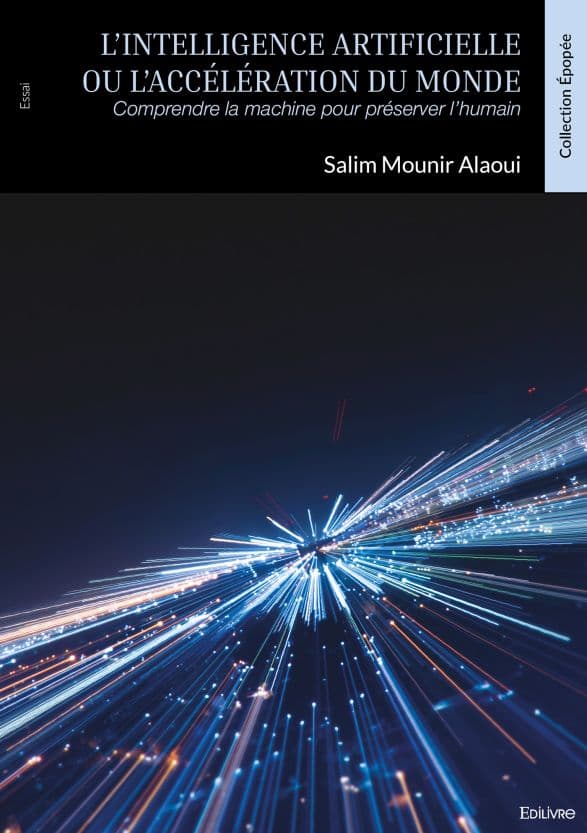
Artificial Intelligence or the Acceleration of the World: Understanding Machines to Preserve Humanity
Excerpts: “The internet does not need less freedom, but more discernment. This means recognizing that not everything that can be produced necessarily deserves to be shared, indexed, or amplified. Freedom of expression is not threatened by limiting noise, but by the inability to distinguish what makes sense from what does not.”
“There is therefore nothing to prevent us from imagining mechanisms that:
- Make automatically generated content visible,
- Highlight authentic human-generated content,
- Hold producers and distributors accountable,
- Reintroduce friction where automation has smoothed everything out.”
Salim Mounir Alaoui, L’Intelligence artificielle ou l’accélération du monde : Comprendre la machine pour préserver l’humain (Nîmes, Édilivre, 2026).
Author

Ph.D. in Artificial Intelligence, Chair of the Innovation Committee at Orange’s CSEC