The skills and organizational structure required to lead a complex project such as a Knowledge Graph-based Network Digital Twin are specific: the design and deployment of a Network Digital Twin (NDT) system based on Knowledge Graphs (KG) is a challenging task, particularly when working on networks at the scale of an operator such as Orange. Such networks consist of multiple technological domains that must be considered simultaneously (e.g., 4G/5G networks, international IPoWDM transmission networks, data centers) to ensure high quality of service through an end-to-end view of systems and data flows. From the NDT perspective, this translates into challenges related to developing a coherent and scalable semantic model of all these domains, as well as integrating heterogeneous data while ensuring traceability (provenance) and data quality and freshness.
In this article, we explain how the LOT4KG methodology [LOT-2022, LOT4KG-2024], derived from academic research, enables us to practically address and organize all the activities and skills required for such a project. Specifically, we present the “LOT4KG for Orange” adaptation, the result of a collaboration between Orange France and Orange Research on the development and deployment of a Knowledge Graph-based Network Digital Twin (KG-NDT) for the monitoring of national networks.
The LOT4KG methodology proves to be an effective and comprehensive framework for guiding a Knowledge Graph-based Network Digital Twin project, particularly when working at the scale of international networks such as those of Orange.
Knowledge graphs at the heart of the digital network twin
Knowledge graphs enable the structuring of heterogeneous data (e.g., network topology, technical logs, operations, stakeholders) using a shared formal vocabulary (ontology). Innovations from Orange Research, such as the Thing’In platform [HF-1] and the NORIA project [HF-2], use this approach, which facilitates the analysis of information by making the relationships between data elements explicit. By leveraging this type of graph,
the KG-NDT provides an accurate and dynamic representation of networks and their ecosystem, accelerating and enhancing the management of complex operational issues, whether involving diagnostics, simulation, or the optimization of network infrastructure and services. It enables users to navigate rich data, cross-reference multiple sources, and generate views tailored to different user profiles. In summary, the Knowledge Graph-based Network Digital Twin is a powerful tool for foresight and decision support, as well as for gaining a comprehensive understanding of the network and its dynamics.
What are the challenges involved in building a Digital Network Twin using a knowledge graph?
The development of a Network Digital Twin based on Knowledge Graphs involves a wide variety of teams, including functional and technical architects, knowledge engineers, domain experts, and operations and quality of service managers. This diversity and the number of teams involved necessitate a specific and rare level of cooperation and coordination. Human and technical challenges arise on a daily basis, and numerous questions arise, including:
- How can one design a robust, multi-domain ontology (or set of ontologies) that meets the company’s specific needs while remaining interoperable with external information systems?
- How can existing ontologies be allowed to evolve over time without jeopardizing the data already stored in the knowledge graph or fundamentally calling into question the algorithms that generate and use the graph?
- How can one begin building a knowledge graph based on existing data schemas and models that are already embedded in the information system’s operations?
- How can one develop and operate multiple knowledge graphs in parallel (for example, one knowledge graph per technical domain or per area of responsibility) and successfully combine them into a coherent meta-graph?
- Is there an extensible reference architecture for a KG-NDT?
- Taking the example of the French national transmission grid alone, it must be capable of handling a throughput of 5,000 events per second in relation to a knowledge graph comprising two million entities and five million edges.
In summary, what are the methodological steps and associated tools that make sense for developing and using a KG-NDT in an industrial setting? The LOT4KG framework addresses these questions by organizing the various stages of building the network digital twin based on a knowledge graph.
LOT4KG: Linked Open Terms for Knowledge Graphs Construction—what exactly is it?
It is a methodology developed by a team of artificial intelligence researchers at the Polytechnic University of Madrid (UPM) that formalizes the lifecycle of a knowledge graph from source data to the final graph and provides a set of associated tools for each stage. A detailed description is available online at https://lot.linkeddata.es/LOT4KG/, and Figure 1 below provides an overview.
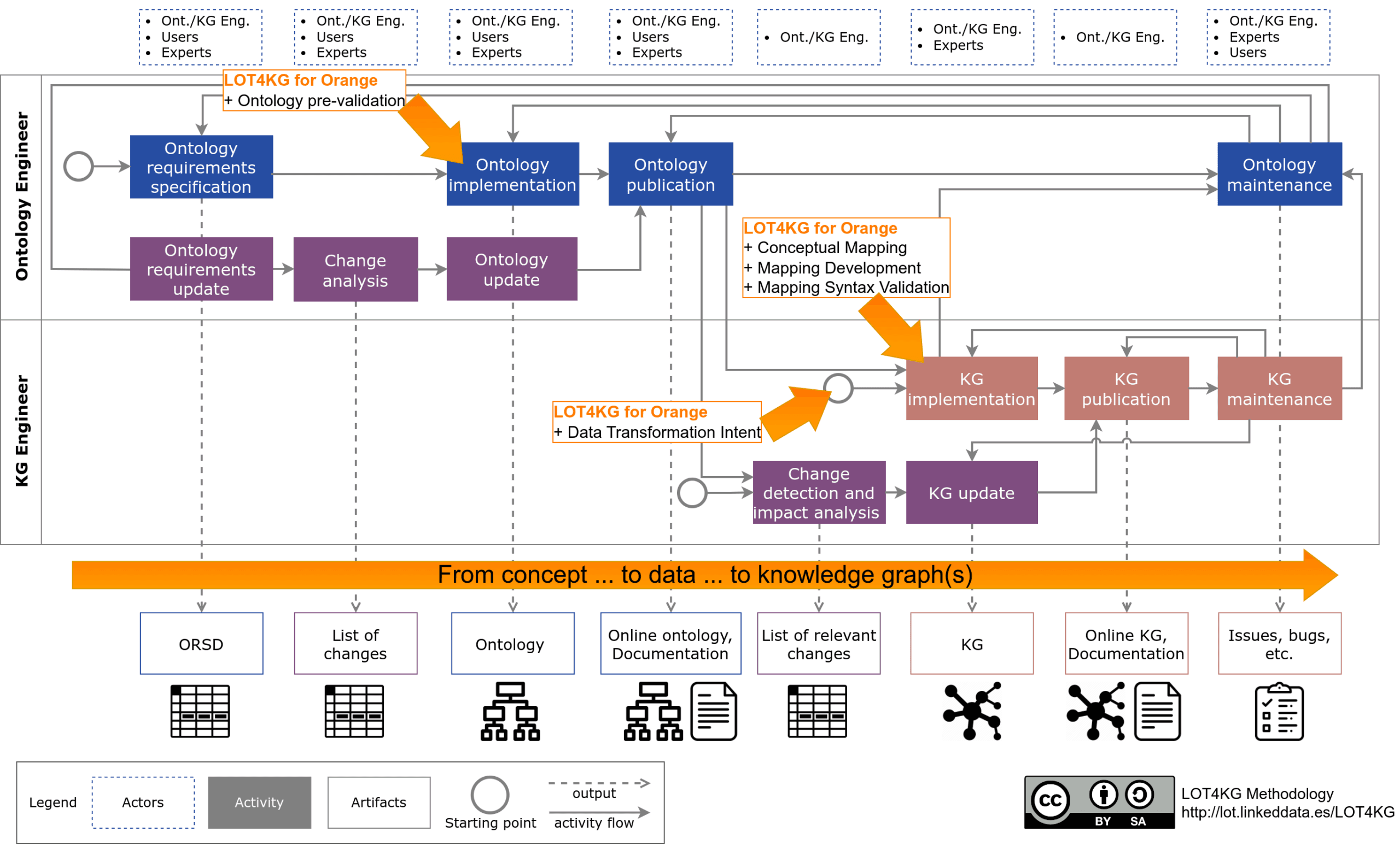
Figure 1: Overview of the “LOT4KG” methodology presented as a process diagram. The additions from “LOT4KG for Orange” are highlighted in orange.
LOT4KG therefore provides a framework for organizing, resolving, and addressing the various challenges listed above. This methodology establishes a common terminology among stakeholders in a KG-NDT project, as well as a process for designing, implementing, and operating a Knowledge Graph-based Digital Network Twin (KG-NDT).
LOT4KG For Orange
The Orange context requires considering the integration of data from various technical and operational domains that are managed independently. This constraint makes it necessary to include the harmonization of knowledge graphs and the participation of diverse business teams at the core of managing a KG-NDT project — elements previously absent from the LOT4KG methodology.
We therefore worked on the “LOT4KG for Orange” adaptation, in collaboration with the researchers who developed LOT4KG, keeping in mind that the generality of the methodology must facilitate the exchange of best practices among scientific, technical, and industrial communities regardless of the field of application. With this objective in mind, we supplemented the methodological process with five new steps (orange arrows in Figure 1) and proposed using the process diagram as a tool for tracking project maturity. These two aspects are detailed below.
Regarding the new steps, we began by strengthening LOT4KG’s “Ontology Engineering” activity by encouraging business teams to systematically establish a list of essential concepts for the domain of discourse to be represented. This results in a list of references to existing vocabularies that could support the modeling effort while promoting the interoperability of representations and reasoning modes (i.e., the logic embedded in the ontology for data interpretation) according to the principles of Linked Open Data.
The following hierarchy enables an approach to design that promotes interoperability:
1. Ontologies exist and are suitable for the application context. No ontology creation is necessary; the project can proceed immediately to the “KG Implementation” phase.
2. There are suitable ontologies, but they need to be adapted to the project context. In this case, existing ontologies are integrated by iterating directly through the “KG Implementation” steps and proposing modifications to the ontology maintainers (for example, new concepts and relationships proposed via GitHub Issues or Pull Requests on the ontologies’ public repositories).
3. If no suitable ontology exists, the missing components must be created. In this type of project, the “Ontology Lifecycle Extension” steps of LOT4KG must be fully applied, while keeping in mind that the developed ontology must fit into an ecosystem of existing ontologies.
Strengthening “Ontology Engineering” activities also involves encouraging the systematic formalization of business needs in terms of competencies (Competency Questions) [CQ-2014]. This typically results in a list of essential use cases to guide the project’s implementation and its functional validation at various stages of the methodology, beginning with the “Ontology Pre-Validation” stage (validation of the data model implementation).
These essential use cases are also useful later in the process, particularly during the “Knowledge Graph Lifecycle” activity (the construction of the knowledge graph(s) for the NDT): they effectively enable the validation of data integration rules by technical domain (the “Conceptual Mapping ,” “Mapping Development,” and “Mapping Validation”) and, ultimately, the consistency of the data modeling and integration rules across the entire KG-NDT. The LOT4KG methodology, adapted in this way, thus enables the management of challenges related to the federation of data from various technical and operational domains.
Regarding project maturity tracking, our research team proposed that KG-NDT stakeholders annotate the LOT4KG for Orange process diagram with a Technical Readiness Level (TRL) [TRL-2017], a list of recommended tools [STH-2024], and the names of the Orange entities involved in each stage. This annotation made it possible, from the very start of the project, to estimate the R&D effort required in relation to both the company’s internal capabilities and available external solutions, as well as to prioritize the actions needed to bring the KG-NDT into production and build the teams’ capabilities.
Conclusion and Outlook
Overall, LOT4KG for Orange — thanks to a comprehensive framework spanning design through operations, coupled with an assessment of technical and organizational maturity levels — enables the smooth progression of the design and deployment of a KG-NDT.
The LOT4KG methodology and its “LOT4KG for Orange” adaptation have proven to be an effective and comprehensive framework for guiding this type of project and for working at the scale of international networks such as those of Orange.
To get started with these methodologies and foster the development of a corporate culture centered on knowledge graphs and their use, we advise every project stakeholder to review the overall process and identify the activities, tasks, and roles that apply to them. It is also recommended that team members use consistent terminology when communicating with one another. The most advanced level of use involves trying out new tools, enriching the definitions of activities and tasks, and refining the proposed lifecycle.
The development and deployment of KG-NDT projects is underway at Orange, with numerous discussions taking place in standards groups (e.g., W3C, IETF, 3GPP, TM Forum) and exchanges of best practices among scientific, technical, and industrial communities. The next steps related to LOT4KG involve continuing to assess the methodology’s suitability for the specific characteristics of each application domain and developing technical solutions that are currently missing or not yet fully mature.
Building on our research, we also anticipate the longer-term need to consider how to ensure consistency among Network Digital Twin projects developed across different organizations, to establish a shared culture around LOT4KG.
This text has been translated by an artificial intelligence.
Read more
- [LOT-2022] M. Poveda-Villalón, A. Fernández-Izquierdo, M. Fernández-López, R. García-Castro (2022). “LOT: An industrial-oriented ontology engineering framework,” Engineering Applications of Artificial Intelligence, 111, 104755. doi: 10.1016/j.engappai.2022.104755
- [LOT4KG-2024] R. Pernisch, D. Chaves-Fraga, L. Stork, D. Conde-Herreros, M. Poveda-Villalón (2024). “LOT4KG: A Joint Methodology for the Ontology and Knowledge Graph Lifecycle,” online: semanticscholar.org/CorpusID:269756401
- [CQ-2014] Y. Ren, A. Parvizi, C. Mellish, J.Z. Pan, K. van Deemter, R. Stevens, “Towards competency question-driven ontology authoring” (2014), The Semantic Web: Trends and Challenges. doi: 10.1007/978-3-319-07443-6_50
- [STH-2024] A. Reiz, F.J. Ekaputra, N. Mihindukulasooriya (2025). “Semantic Tool Hub: Towards a Sustainable Community-Driven Documentation of Semantic Web Tools.” The Semantic Web: ESWC 2024 Satellite Events, vol. 15344, in Lecture Notes in Computer Science, vol. 15344. doi: 10.1007/978-3-031-78952-6_48.
- [TRL-2017] Pierre Devalan (2017). “Transfer of Innovative Technologies,” Techniques de l’ingénieur: Management and Innovation Engineering. doi: 10.51257/a-v1-ag252.
Authors

Lionel Tailhardat received the M.Sc. degree in telecommunication networks and broadband technologies from the Conservatoire National des Arts et Métiers (CNAM), France, in 2018, and the Ph.D. degree in data science and knowledge engineering from EURECOM, Sorbonne University, France, in 2024. Currently, he is a full-time Researcher with Orange Research. Prior to pursuing research, he held various positions in network operations and monitoring system architecture. His research interests include distributed and dynamic systems, data science and graph theory, coding schemes, and high-performance computing.

Devops Engineer, Orange France