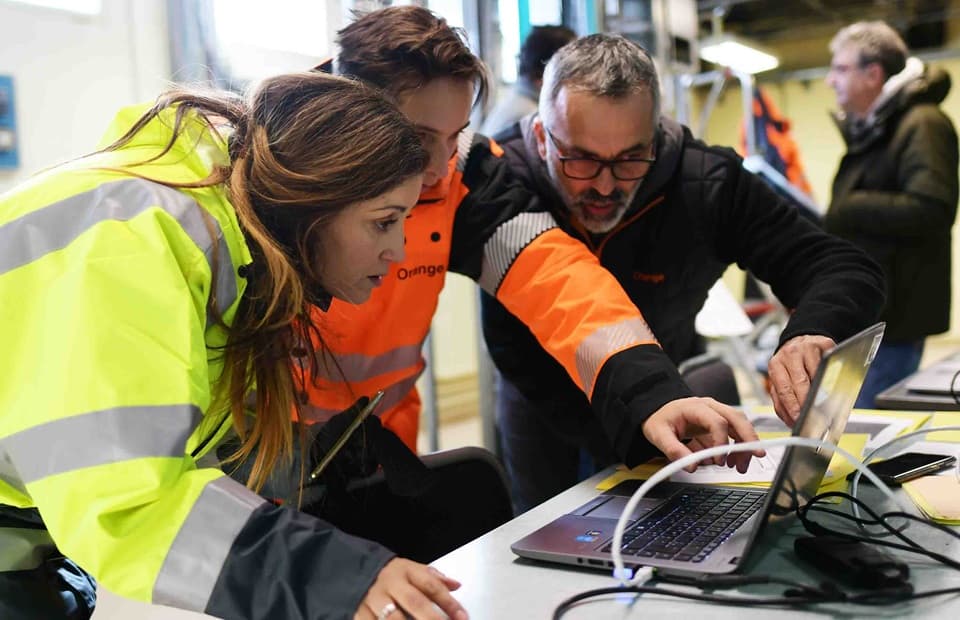
This partnership between a tech company and a research institution is no coincidence. For years, teams from Orange in Meylan and CEA Leti in Grenoble have been collaborating on flagship European projects for the networks of the future (6G). “This collaboration has deep roots: through European projects like Hexa-X, we already had common ground with the CEA. We discovered many areas of alignment, both in terms of specific topics and our overarching vision,” explains Quentin Lampin, a senior researcher at Orange. He co-leads the laboratory with Emilio Calvanese Strinati, scientific director at CEA Leti, who elaborates on this shared overarching vision: “The need to semantically align the representation of messages, their interpretation, and their use, as well as the need to develop demonstration platforms capable of highlighting the operational value and concrete benefits of semantic communications.”
In the future, networks will no longer carry just bits, but meaning.
He notes that, on the CEA side, expertise has been built up over nearly a decade: “We launched our work on semantics as early as 2016, and the first real results began to emerge in 2021, when we started defining the basic modules of a semantic communication system.” The chosen framework stems from this. “A joint lab is, above all, a collaboration between two entities on a specific theme, with objectives reviewed annually, rather than a service aimed at a specific result,” explains Quentin Lampin.
Conveying meaning rather than bits
Today’s communication networks were designed with one primary goal: to ensure the faithful reproduction of every bit transmitted. Semantic communication, on the other hand, no longer seeks to guarantee perfect data reproduction and considers a message to have been successfully received when the receiver correctly understands its meaning, even if not all bits have been faithfully reproduced. However, this requires that the sender and receiver share the same interpretive framework. “The key issue is semantic alignment. If two people say to each other ‘Let’s meet up this weekend,’ one from a Western culture and the other from the Arab world, the words are perfectly transmitted, but they don’t understand each other,” explains Emilio Calvanese Strinati. “We’ve set two objectives regarding semantic representations: how do we encode them, and how do we compress them for transmission? We also want to work on semantic control, namely the set of mechanisms that make these communications possible within the network,” explains Quentin Lampin.
More Efficient Networks
The energy challenge is central: by transmitting only the essentials, semantics significantly reduces data volumes. “In certain contexts, we can reduce the amount of information to be transmitted by a factor of 1,000 for equivalent information,” says Emilio Calvanese Strinati. However, this gain comes at a cost. “The energy per transmitted bit may increase, because we’re adding a layer of encoding and decoding. But the number of bits needed to achieve a goal is so greatly reduced that, overall, we significantly lower the energy consumed. ”For Orange,” notes Quentin Lampin, “projects incorporate frugality as a matter of principle, so “semantic representation is also a way to extract the information that is truly relevant for a given use; if we transmit only what is useful, that means saving network resources.”
Standardization Challenges
Faced with AI giants, Orange does not aim to compete with model providers, but rather to set the rules of the game. “Our goal is not to offer models. Just as in video, we’re not playing the role of Netflix, but rather that of standardization bodies like MPEG, which define the encoding standards and mechanisms for adapting the stream to network resources,” summarizes the Orange researcher. The shift toward semantic communications in the coming years heralds a reorganization of infrastructure, as AI moves closer to the user. “We’ll see the emergence of the equivalent of CDNs, but for models that are much closer to users: small models capable of handling most tasks, which only call on heavier models when necessary,” he adds.
Two cultures, one critical mass
Both partners aim to make an impact in an increasingly fast-paced global competition. “The challenge is to bring together two leading teams to create critical mass and not fall behind as the industry accelerates. “We were pioneers, but industry interest is now very strong—perhaps even greater than academic competition,” explains Emilio Calvanese Strinati. Complementary expertise is therefore at the heart of this alliance: “The teams at Orange have highly specialized expertise in AI applied to communication systems, particularly in AI agents. For us, this is a true synergy.” For the next five years, the AI-Native Communications laboratory is anchoring this ambition in a framework of technological sovereignty: enabling France and Europe to actively contribute to the development of standards for the smart networks of tomorrow.
This text has been translated by an artificial intelligence.
People we quote
Quentin Lampin
A senior researcher at Orange (in Meylan), Quentin Lampin holds a Ph.D. in computer science from INSA Lyon and has fifteen years of experience in optimizing network protocols. His work focuses on machine learning for networks and networks supporting AI, ranging from the physical layers of the IoT to communication between agents. He has supervised two doctoral theses on 6G and AI—one of which is related to the IoT—and holds 35 European and U.S. patents.
Emilio Calvanese Strinati
As Scientific Director of the 6G program at CEA-Leti (Grenoble), Emilio Calvanese Strinati leads research programs on the wireless networks of the future and 6G. A pioneer in semantic communications, he coordinates the European 6G-GOALS and 6G-DISAC projects, as well as the 6GARROW project between Europe and Korea. A Ph.D. graduate of Télécom Paris, he is the author of more than 200 publications and approximately 100 patents.
Read more