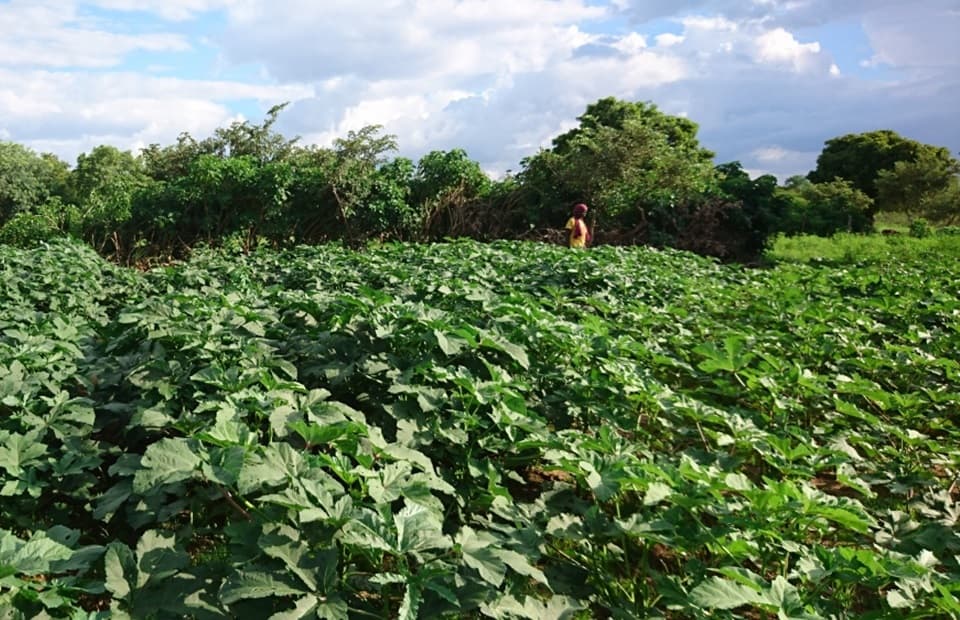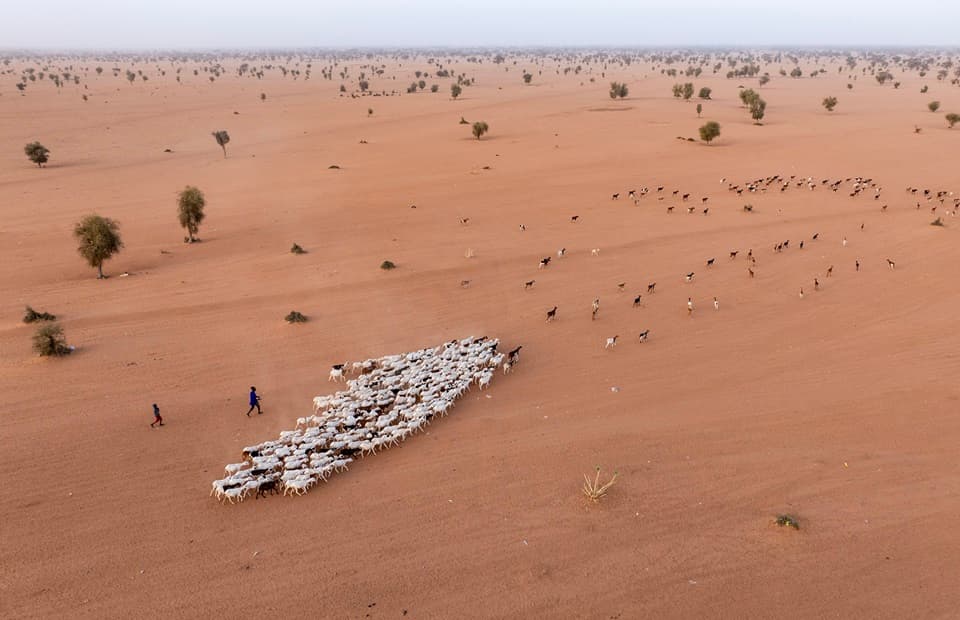
Senegal, like many countries in sub-Saharan Africa, exhibits a high level of human mobility. The population, primarily engaged in agropastoral activities, has migrated seasonally for centuries to diversify their livelihood (Adriansen, H. K. (2008), Lalou and Delaunay, 2017). Agricultural production and income heavily depend on rainfall and are vulnerable to climatic shocks. Consequently, migration is often employed as a strategy to cope with variations in weather, climatic and environmental conditions, either ex ante to diversify income sources or ex post in response to adverse shocks (De France et al., 2023).
This study explores the relationship between human mobility and environmental stressors, with a specific focus on temporary internal migration, which is often understudied due to data limitations. Understanding the scale of internal climate migration is critical to countries so they can plan and prepare.
Mobile phone data offer significant advantages over more traditional survey-based instrument to measure temporary internal migration
Using mobile phone data to infer temporary migration patterns
Previous research on migration has primarily relied on survey data and focused on long-term movements. However, finer mobility patterns such as seasonal, circular, or temporary migrations clearly surpass longer-term movements (Coffey et al. 2015; Bryan et al. 2014). Yet, capturing these movements with traditional survey methods is significantly more challenging. In this regard, mobile phone data have emerged as a promising alternative for studying more subtle human movements, particularly in developing contexts (Blumenstock 2012; Demissie et al. 2019).
This study uses Call Detail Records (CDR) from millions of Sonatel (Orange Senegal) customers over a three-year period (2013-2015)[1]. While CDR are traditionally collected by mobile network operators for billing purposes, they contain information than can effectively capture population movements. The spatial density of antennas, combined with frequent phone usage, typically result in highly granular data making it a unique resource to study human mobility.
Mobile phone data offer significant advantages over traditional survey-based instruments for measuring temporary internal migration. These data avoid recall bias, a common issue in surveys, especially for short-term events. Additionally, they allow for the measurement of short-term mobility patterns at the national level and over several years, all at a fraction of the cost of conventional data collection. In sub-Saharan Africa, where resources are limited, mobile phone data can provide invaluable insights into internal temporary migration dynamics. Conversely, unlike traditional survey data, the sample of mobile phone users is not random which may affect its representativeness of the total population. Nonetheless, the study indicates that selection biases are minimal, and the data likely represent a substantial portion of the adult population in both rural and urban areas.
Migration events are identified in the CDR using a clustering method based on recent work by Chi et al. (2020). User-level migration trajectories are then aggregated to produce spatially detailed measures of temporary migration (see Blanchard and Rubrichi, 2024).
Describing temporary migration patterns in Senegal
The mobile phone data provide novel insights into the size, timing, duration, and direction of temporary migration flows in Senegal at an unprecedented level of spatial and temporal resolution. Several key findings emerge from this analysis.
First, data indicate that temporary migration is prevalent in Senegal, with an estimated 3.6 million migration events of at least 20 days occurring in 2015. Considering that multiple events may involve the same individual, approximately 29% of the adult population—about 2 million people—engaged in a migration event of at least 20 days that year. In contrast, long-term migration was estimated at around 2%, highlighting the significance of short-term movements.
Second, the median and mean durations of temporary migration episodes in Senegal are estimated at 38 and 50 days, respectively. The variation in duration is relatively modest, with over 70% of migration episodes lasting less than 2 months.
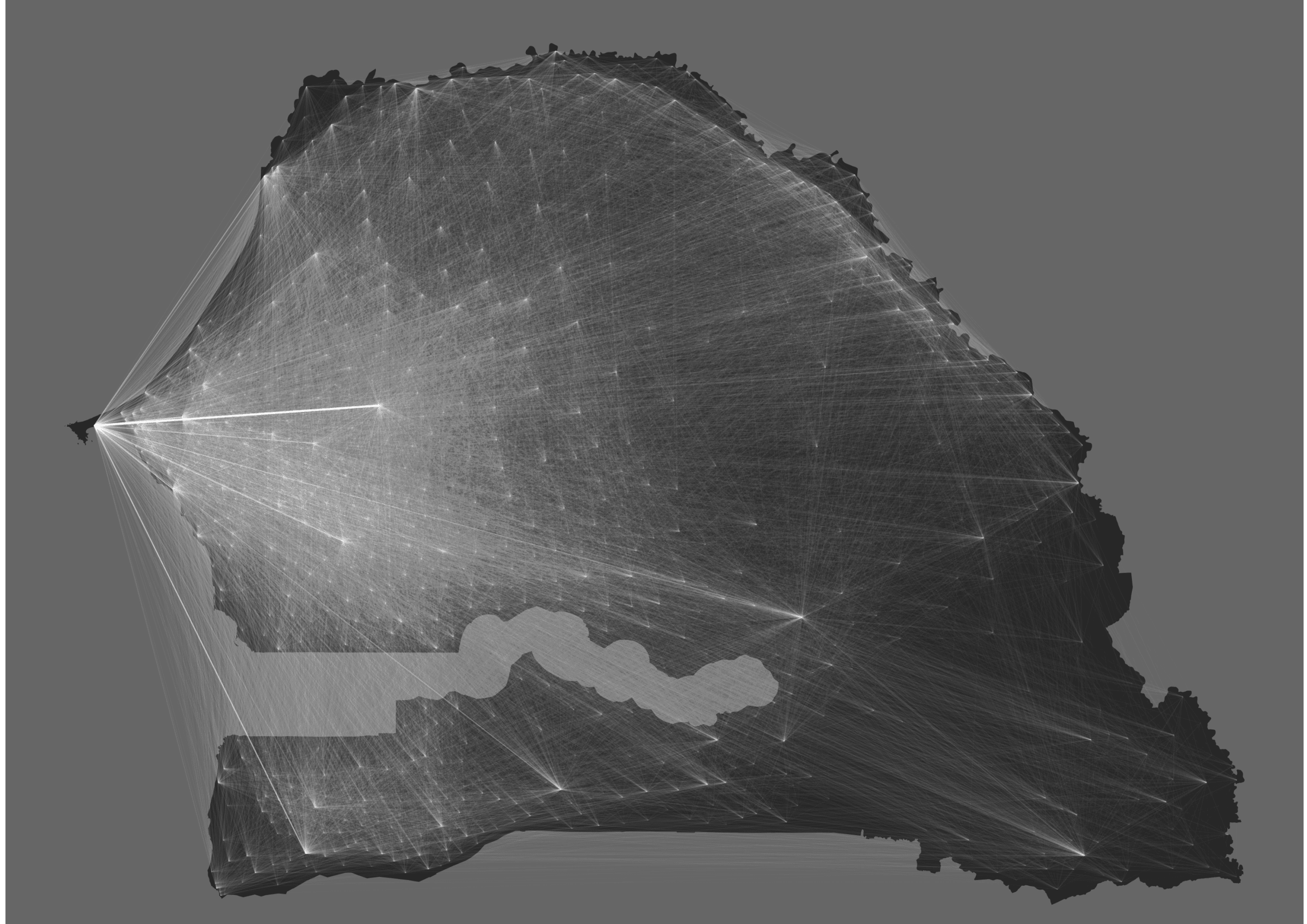
Third, migration flows in Senegal are widely dispersed, forming an extensive network of connections within and between rural and urban areas (Figure 1). Major cities like Dakar, Touba, Ziguinchor, Thiès, and Kaolack not only send many migrants but also attract temporary migrants from across the country, with Dakar alone drawing 23% of the total flow in 2015. Notably, 63% of migration flows originate from rural areas, with over half of these movements directed to other rural locations, primarily involving short distances.
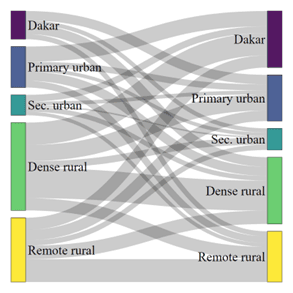
Figure 1. Migration flows between rural and urban zones in 2015.
Finally, the temporal distribution of short-term movements reveals distinct seasonal patterns. In all three years studied, there is a marked increase in the migrant population starting in June and peaking in August-September, corresponding to the growing season. Notably, the number of migrants more than doubled from early June to late September in 2013, primarily driven by rural-urban migration. This trend indicates a systematic labor shift from rural to urban areas during the rainy season (June-October), suggesting income diversification strategies. This finding challenges the perception that temporary migration is limited to off- rural-urban movements and aligns with recent local observations in Senegal (Delaunay et al., 2016). Additionally, significant rural-to-rural movements occur during the rainy season, coinciding with heightened agricultural activities, and the stock of rural migrants remains elevated post-October, likely due to harvest activities.
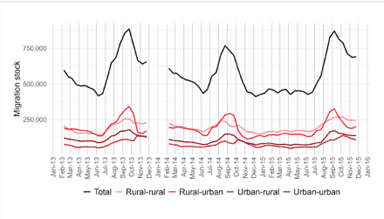
Figure 2. Stock of temporary migrants in the period 2013-2015 by origin destination zone.
Assessing the impact of rainy season conditions on temporary migration
Mobile phone data indicate consistent temporary migration patterns over several years, though these patterns may be influenced by rainy season conditions. On the one hand, poor rainfall conditions at an individual’s home location can act as a push factor encouraging migration to diversify income sources (Findley 1994; Henry et al. 2004; Delaunay et al., 2016). On the other hand, it may also heighten liquidity constraints, complicating the migration process. Additionally, adverse rainfall conditions at potential destinations can diminish their appeal. To quantify these effects, origin-destination migration estimates from mobile phone data are combined with satellite-based rainfall measurements from 2013 to 2015. Regression methods are used to assess how rainy season conditions at both origin and destination affect migration numbers, employing half-month measures to accurately capture the timing of the effects throughout the agricultural year.
The analysis reveals several key findings:
- Impact of adverse rainfall conditions on migration: Poor rainfall conditions at origin during the rainy season lead to a significant decline in migration to both rural and urban areas during the harvest season, and to an increase in migration to other rural areas during the off-season.
- During the off-season, rural-to-rural migration in response to poor rainfall are stronger for poorer areas and with a more developed livestock sector. Poorer households seem to rely more on migration as a coping strategy, due to financial constraints and limited local employment opportunities. Pastoral households, which are naturally mobile, tend to migrate more during periods of poor rainfall to seek water and fodder resources away from their usual homes.
- Consequences of poor rainfall on subsequent seasons: Drier conditions lead to a rural-to-rural spatial redistribution during the subsequent off-season.
- Negative effects on migration: Overall, drier conditions adversely affect both the ability to migrate during the harvest season and the anticipated returns from migration. A simulation exercise reveals that, compared to a neutral scenario in which all locations receive average precipitation levels, a drought scenario such that of 2014 induces a 17% decrease in temporary migration during the harvest season.
Conclusion
Short-term internal migration is crucial for economic decision-making in developing countries. Yet, measuring it accurately remains challenging. The study demonstrates the potential of mobile phone data to shed light on temporary migration patterns in Senegal, particularly in response to rainy season conditions.
The study analyzes how rainfall at both origin and destination affects migration decisions, revealing that while drier conditions reduce migration during the harvest season, they can lead to rural-to-rural relocation in the off-season. Notably, there is little evidence of significant rural-to-urban migration following adverse conditions, contradicting common narratives.
The findings highlight the need for tailored policies and response options based on local sensitivities to rainfall conditions. They also suggest that interventions to support production and consumption during adverse climatic conditions must be carefully timed to be effective.
Mobile network operators can play a crucial role in informing such policies through their data. Orange’s Flux Vision solution could serve as a useful tool to replicate such results, contributing to Orange’s ambitions to be a player in economic, social, and environmental resilience.
[1] Mobile phone data were provided by Sonatel (Senegal) as part of the D4D Challenge and the OPAL project.
Authors
Paul Blanchard
Development economist at the French National Research Institute for Sustainable Development (IRD)
Virginie Comblon
Researcher at Orange Labs -Department of Sociology and Economics of Networks and Services (SENSE)
Flore Gubert
Research Director at French National Research Institute for Sustainable Development (IRD)
Anne-Sophie Robilliard
Research Fellow at French National Research Institute for Sustainable Development (IRD)
Erwan Le Quentrec
Team manager and Researcher at Orange Labs -Department of Sociology and Economics of Networks and Services (SENSE)
Stefania Rubrichi
Research scientist at Orange Labs -Department of Sociology and Economics of Networks and Services (SENSE)