Funded by PRIMA, the collaborative RESILINK project aims to develop a “platform of platforms” designed to support small farms in the Mediterranean basin as they face global challenges and major crises, such as the one caused by COVID-19. The chosen approach is based on the optimization and regionalization of agricultural value chains.
The project was coordinated by the University of Pau and the Pays de l’Adour (UPPA), alongside a consortium of institutions and schools specializing in agriculture and technology in Morocco, Algeria, and Egypt.
The Challenge of Resilience in the Face of Crises
Small-scale producers in North Africa regularly face events that disrupt their relationships with customers, suppliers, and other stakeholders in their ecosystem: security tensions, climate-related hazards (droughts, storms), natural disasters—such as the 2023 earthquake in Morocco—or health crises, such as the 2020 pandemic.
In such contexts, restrictions on movement hinder not only the marketing of agricultural products but also access to distant resources. The impact on farmers’ incomes is often significant, undermining an already precarious economic balance in many regions of North Africa.
RESILINK aims to strengthen the regional agri-food value chain while contributing to several Sustainable Development Goals (SDGs). To achieve this, the project focuses on better utilization and optimized sharing of local resources, as well as easier access to regional markets.
Specifically, the partners have developed service proposals designed to ensure continued access to resources and commercial outlets during times of crisis. The ultimate goal is to preserve and strengthen short supply chains by prioritizing local trade.
Technology in the Service of the Idea
The project relied on advanced digital technologies and cutting-edge architectures and protocols to enable flexible, real-time information exchange. On the user side, we designed and developed a mobile app (functional prototype) for smallholder farmers, as well as an interface for easy, fast, and intuitive interaction with the RESILINK digital resource management platform.
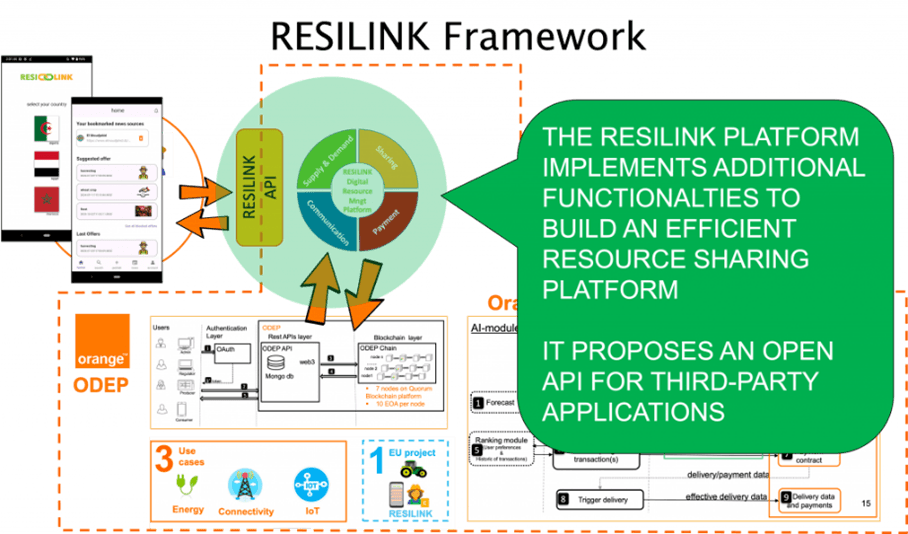
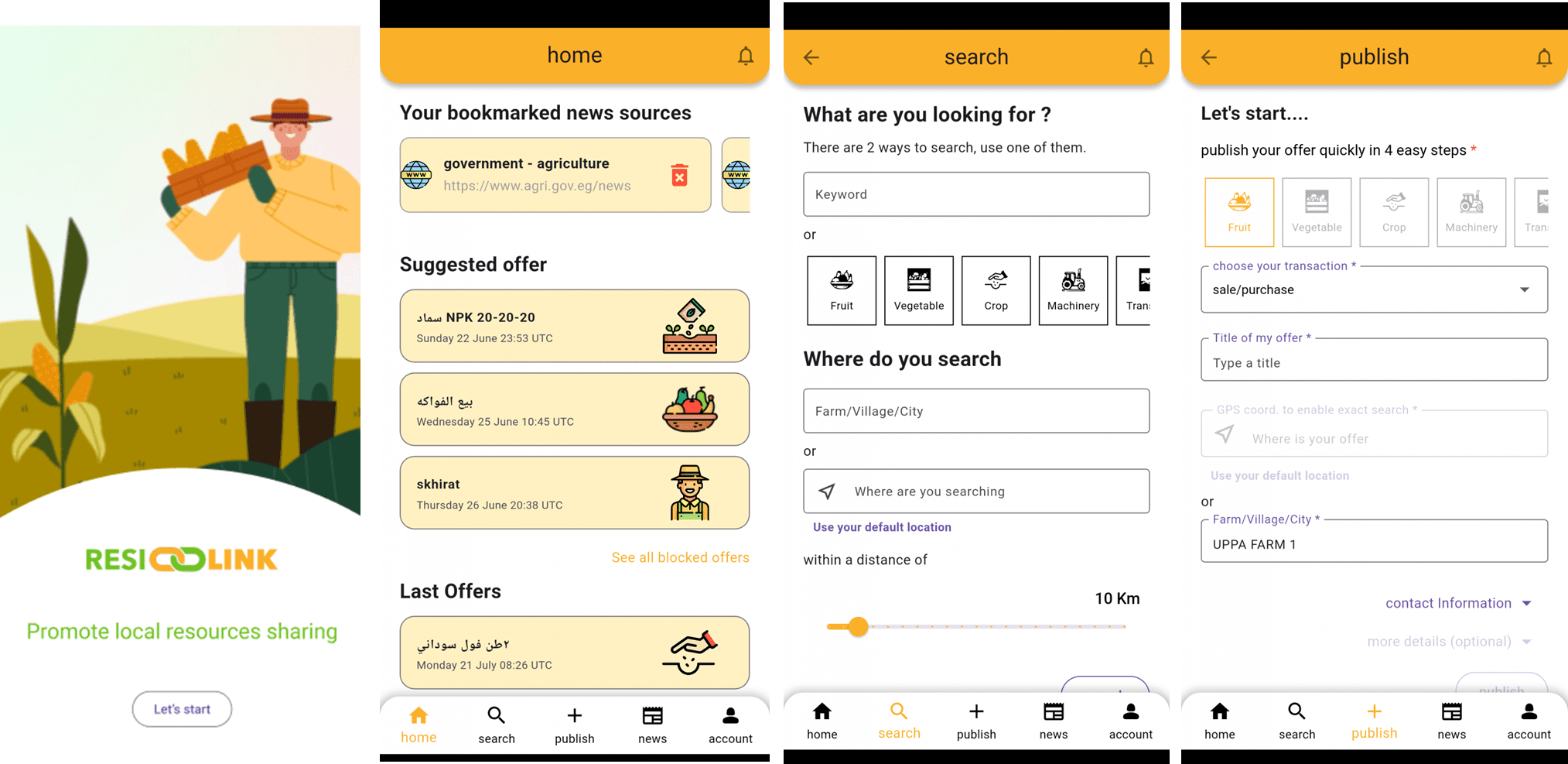
A few screenshots of the app prototype
The RESILINK mobile app allows users to sell, search for, lend, rent, donate, and more—all related to agricultural goods and services: production, tools and machinery, storage, labor, etc. The home screen displays official information sources so that alerts are clearly visible. Each partner country was able to test a localized version of the service, available in English and Arabic.
Close to the Field: A User-Centered Design
From the very start of the project, local stakeholders on one hand and potential users on the other were brought into the process to ensure that the planning and design took into account the realities on the ground, as well as the needs, limitations, characteristics, and expectations of the service’s target audience. To achieve this, several meetings were organized to apply the design thinking methodology (user-centered design). Surveys were conducted in each country to better understand the users. The initial mockup of the RESILINK app and its subsequent prototype underwent user testing and experimentation within the framework of Living Labs. To facilitate the interaction phases, guides, user manuals, and videos were produced (on conducting interviews, using the app, etc.). Collecting user feedback allowed us to iterate on the proposal to refine it and best meet the expectations of the test users. While the service was initially designed for one-time use (in the event of a crisis, as explained earlier), feedback from the tests revealed broader expectations.
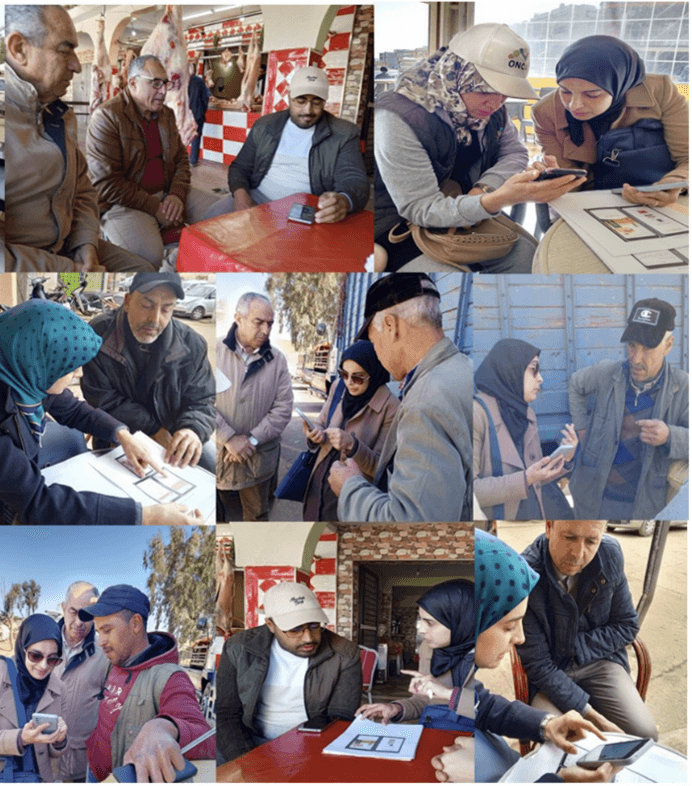
Interactions with farmers in Morocco (courtesy of H. Lionboui, INRA Morocco)
Technical developments: from blockchain to AI-assisted software development
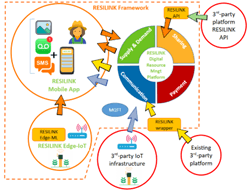
As the project progressed, the use of a blockchain-based technical foundation no longer seemed suited to user needs and local deployment contexts. This technical choice initially appeared to be the most appropriate due to the guarantees it offers in terms of transparency, free and unfiltered access to markets, and the reduction of intermediaries (Kos and Kloppenburg[i[1] ], 2019). However, these guarantees require a more resource-intensive IT infrastructure that can be difficult to deploy and maintain within the fully decentralized approach proposed by the RESILINK project. It seemed more prudent to develop and offer an open API to facilitate the use of RESILINK’s technical foundation by third-party applications. This approach, referred to as the “platform of platforms” by RESILINK, stems from the desire to move away from isolating platforms—as is the case with most platforms currently in use—and instead enable them to collaborate by allowing for the seamless exchange of data between them. The goal is to develop a more comprehensive ecosystem. In the age of AI, the development of new applications that will use RESILINK’s technical foundation is facilitated by making the platform’s source code, its open API, and its detailed documentation available. For example, Orange Research demonstrated during a webinar how a complete application for renting solar microgrid-type energy solutions was developed and deployed in less than three days!
The ODEP (Orange Decentralized Exchange Place) platform, which manages transactions and the blockchain, can also be retained within the architecture and software components to be deployed in cases where advanced features related to the blockchain approach remain necessary. However, in Living Labs pilot projects, the RESILINK server manages all transactions through an open and flexible API to provide features better tailored to users’ needs.
This open API thus enables the “platform of platforms” approach, in which the ecosystem no longer relies on isolated and competing platforms. To demonstrate and validate this approach, Orange has also developed a proof-of-concept as part of the RESILINK project. It is a simple application called LocKitSolar that uses the RESILINK server and its open API to quickly deploy a rental service for various solar-powered tools designed for agricultural activities. This use case is linked to several research projects led by Orange in the MEA (Middle East and Africa) region.
The RESILINK server was also designed to be very lightweight; it can be deployed directly on laptops or even on single-board computers such as a Raspberry Pi. This lightweight server can handle most of the essential features of the RESILINK platform (news feeds, posting offers, searching for offers, and connecting users). The idea is to enable the deployment of multiple lightweight RESILINK servers, each covering a specific geographic area, in order to effectively manage crisis situations at the local level. The phased deployment of these servers thus offers a very high level of flexibility. This capability represents a major step forward in the “platform of platforms” approach, in which the RESILINK server can be deployed for other applications, thereby fostering local innovation.
Orange’s involvement and the takeaways for the operator
As part of this collaborative project, the Orange Research teams contributed to architectural tasks, provided advice on the deployment of technical platforms (including ODEP for blockchain), participated in the co-design of the RESILINK mobile app and in supporting the Living Labs in various countries, and took part in communication initiatives, such as the Agro IT Days in Morocco in 2023[i] . We also demonstrated an API capable of interfacing with the app.
By helping to build this toolkit tailored to the needs of small-scale producers in North Africa, Orange demonstrates its ability to offer value-added services to its customers in the MEA region by leveraging its technical assets and expertise, particularly in architecture and user experience design. After being presented to Orange’s subsidiary in the Republic of Guinea, the project will take on a new dimension by becoming an agricultural marketplace that enables industry stakeholders to more effectively sell, search for, buy, rent, lend, and more—including agricultural products, goods, and services—with a business model tailored to the local context. Orange Innovation will support the subsidiary in 2026 with this development.
This text has been translated by an artificial intelligence.
[1] https://doi.org/10.1016/j.cosust.2019.10.011
Read more
Project website: resilink.eu
Authors
CongDuc Pham
Professor in the Department of Computer Science at the University of Pau and the Pays de l’Adour RESILINK Project Coordinator
Véronique Henry
Research Project Manager, Orange Innovation
Software Architect Orange Innovation
Bruno Conquet
Head of the “Leapfrogging Business in MEA” Research Program, Orange Innovation